AI Coding Agents Explained: 13 Primitives Across 5 Tools
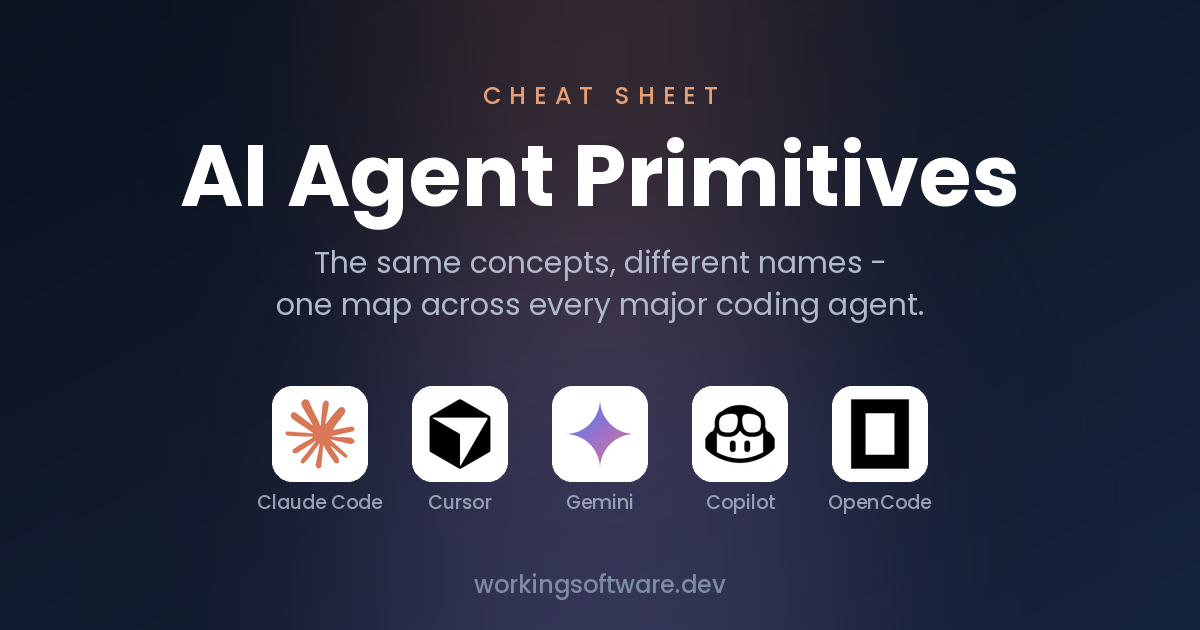
AI coding agents use the same concepts under different names. This guide maps 13 agent primitives across Claude Code, Cursor, Gemini, Copilot and OpenCode.
Every week, AI coding tools introduce new features, rename old ones, and invent fresh terminology for concepts that often already exist elsewhere.
What one tool calls a Skill, another calls a Command. What appears as Rules in one product shows up as Memory or Instructions in another. Keeping up with the vocabulary is becoming harder than understanding the underlying concepts.
The good news: most AI agent tools are built from the same small set of fundamental building blocks.
Instead of learning each tool's terminology separately, it's far more useful to understand the underlying agent primitives. Once you know these primitives, you can quickly understand how Claude Code, Cursor, Gemini, Copilot, OpenCode, and future tools fit together - even as their feature names continue to change.
This guide breaks down the most important AI agent primitives, explains what they do, and maps the terminology used across popular tools.
Download the free cheat sheet as PDF below👇
Generic primitives
Instructions / Rules
Persistent guidance, conventions, and knowledge for the agent. Loaded every session so the agent stays anchored to your project's reality.
Examples:
- Architecture rules
- Coding guidelines
- Testing strategy
- Deployment strategy
- Git Workflow
Mapping note: AGENTS.md is emerging as a cross-vendor convention for this primitive and is now read by several tools. Vendor-specific variants include CLAUDE.md, GEMINI.md, and .cursorrules / rule files.
Prompts / Commands
A reusable task description, often manually invoked.
Examples:
/review→ initiate a code review/create-adr→ create an architecture decision record for a specific aspect/write-tests→ write unit tests for a specific class, component, …
Skills
A packaged capability with instructions, resources, and optionally scripts. Unlike a command, a skill can bundle reference material and executable helpers, and can often be invoked autonomously by the agent when relevant - not just manually.
Examples:
- Generate a C4 model
- Perform a security review
- Generate test data
Agents / Subagents
A specialized role with its own task, context boundaries, and sometimes its own tool permissions. The point is context isolation: a subagent works in its own window so it doesn't pollute the main session.
Examples:
- Architect Agent
- Reviewer Agent
- Tester Agent
- Requirement Engineer Agent
Modes
A runtime behavior switch for the same agent, as opposed to a separate role. Worth distinguishing from agents/subagents because it changes how the agent acts rather than who it is.
Examples:
- Plan mode (think first, don't edit)
- Ask / read-only mode
- Edit / auto-accept mode
- Output style / persona
Hooks
Deterministic automation triggered by lifecycle events. Hooks are code, not prompts - they fire predictably regardless of what the model decides.
Examples:
- Before tool use
- After file change
- Before commit
- After session start
Tools / MCP Servers
External capabilities and data sources made available to the agent.
Examples:
Context References / Mentions
The manual mechanism for pulling specific things into the current context - distinct from Memory (which is persistent and often automatic) and from Tools (which are external). This answers the question: what is the agent looking at right now?
Examples:
@file/@folderreferences@symbol(a specific class or function)@url/ docs references- Pinned or attached files
Memory / Context Store
Persistent context that survives across sessions.
Examples:
- Project memory
- Personal preferences
- Workspace memories
Codebase Indexing / Retrieval
Semantic search over a large codebase (embeddings, indexing) so the agent can find relevant code without you pasting it in. Often invisible and automatic, but it's a real primitive - it's how the agent retrieves from a repo too big to fit in context.
Examples:
- Repository embedding index
- Semantic "find related code"
- Documentation / knowledge indexing
Permissions / Sandboxing / Autonomy
The safety boundary: what the agent is allowed to do, and how much it can do without asking. Easy to overlook because it lives in settings, but it's the difference between a helpful assistant and an unsupervised process running shell commands.
Examples:
- Allow / deny lists for tools and commands
- Auto-approve rules
- Sandboxed execution
- Autonomy levels (ask everything ↔ fully auto)
Checkpoints / Sessions / State
Within- and across-session runtime state: the ability to rewind, restore, resume, and compact. Distinct from Memory - Memory is what the agent remembers, checkpoints are being able to undo and go back.
Examples:
- Checkpoint / rewind to an earlier point
- Session resume
- Context compaction
- Undo of agent edits
Packages / Plugin Extensions
A distribution unit that bundles skills, rules, hooks, commands, and MCP servers into one installable thing.
Examples:
Free Cheat Sheet as PDF
Every AI coding tool calls the same things by different names. This one-page cheat sheet maps them all - 13 agent primitives across Claude Code, Cursor, Gemini, Copilot and OpenCode, each linked to the official docs. Grab it free below 👇